Course Description
Foundational course covering binary numbers, logic gates, Boolean simplification, combinational circuits, and finite state machines. Students move from number systems and Boolean algebra to the design of combinational and sequential circuits, and build and test their designs in the laboratory.
- Course code22241
- LevelUndergraduate
- TypeLecture & Lab
- Leads to22344 Microprocessors
Key Topics
- Number systems, binary arithmetic, and 2’s complement representation.
- Boolean algebra, Karnaugh maps, and logic gate minimization.
- Multiplexers, decoders, adders, and arithmetic circuits.
- Flip-flops, counters, shift registers, and Finite State Machine (FSM) design.
Topics Covered
| # | Topic | Content |
|---|---|---|
| 1 | Binary systems | Number bases and conversions, complements, signed numbers, binary codes |
| 2 | Boolean algebra & logic gates | Theorems, Boolean functions, canonical and standard forms |
| 3 | Gate-level minimization | Karnaugh maps, don’t-care conditions, NAND/NOR implementation |
| 4 | Combinational logic | Adders, subtractors, comparators, decoders, encoders, multiplexers |
| 5 | Synchronous sequential logic | Latches, flip-flops, state diagrams and finite state machines |
| 6 | Registers & counters | Shift registers, ripple and synchronous counters |
| 7 | Memory & programmable logic | RAM, ROM and programmable logic devices |
Textbook
- M. Morris Mano and Michael D. Ciletti, Digital Design, Pearson.
Video Lectures
Recorded lecture demonstrations, practical laboratory tutorials, and student video presentations are collected in one YouTube playlist.
Open the playlist on YouTube Start with the first videoInteractive Labs
Browser-based tools for practising the course material. Click a lab to open it in a new tab.
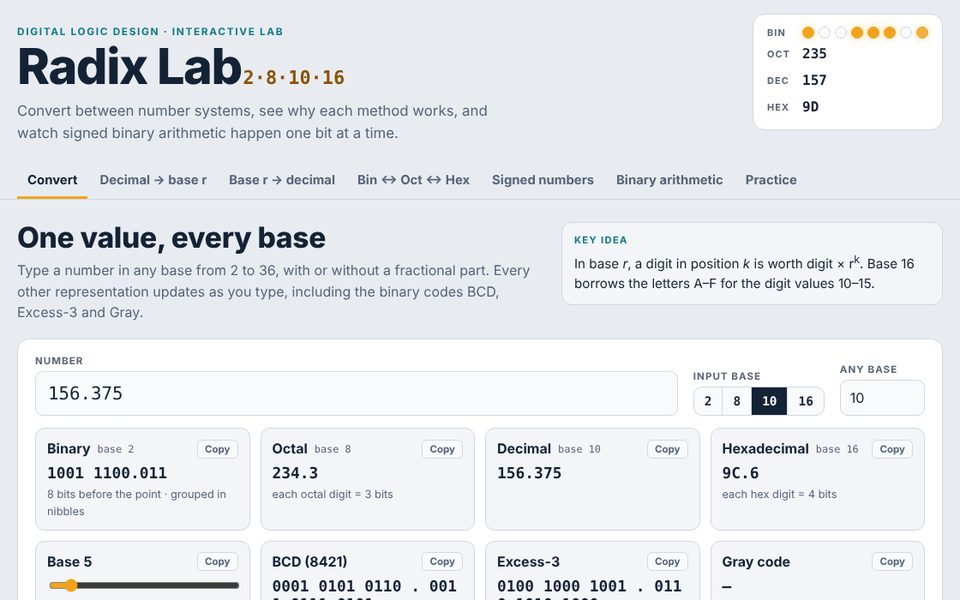 Chapter 1 · number systems
Radix Lab
Convert between bases 2 to 36 and see why each method works: binary codes (BCD, Excess-3, Gray), signed numbers, and binary arithmetic shown one bit at a time.
Open in a new tab ↗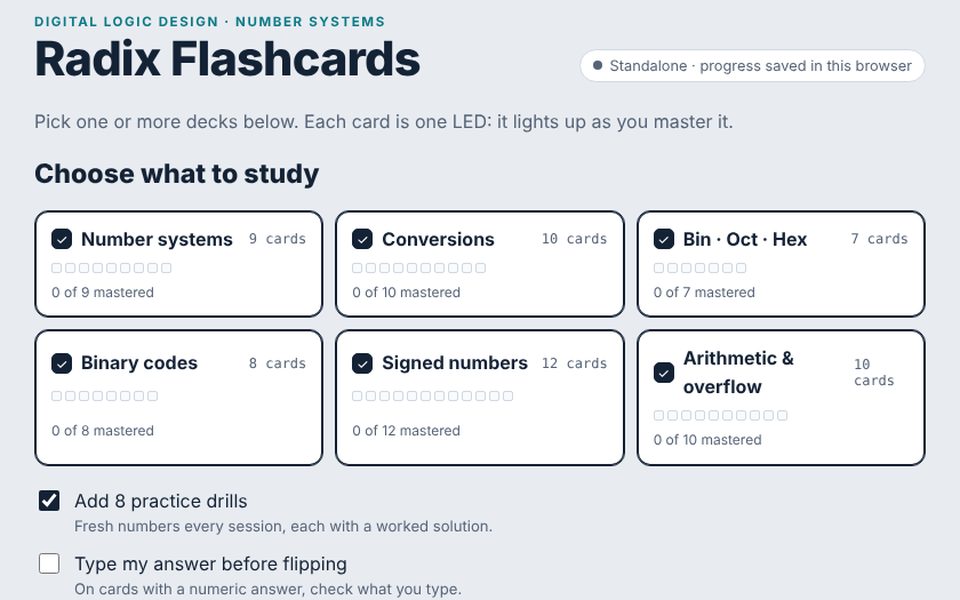 Chapter 1 · review & drills
Radix Flashcards
Six review decks on number systems, conversions, codes, signed numbers and overflow, plus fresh practice drills with worked solutions. Progress is saved in your browser.
Open in a new tab ↗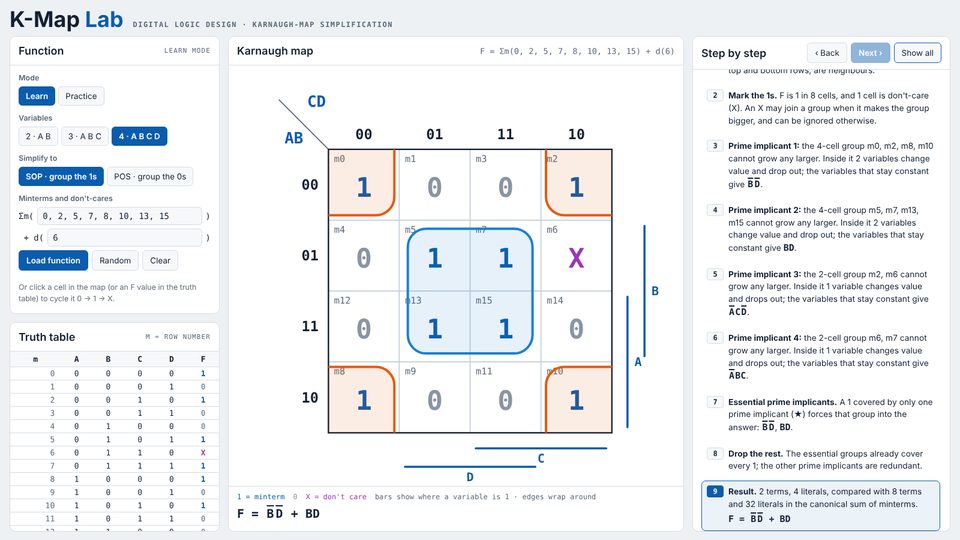 2–4 variables · SOP & POS · graded practice
K-Map Lab
Simplify functions on a Karnaugh map step by step: Gray-code adjacency, prime implicants, essential prime implicants and the minimal cover. Then practise: draw your own groups and get instant feedback on validity, primality and minimality.
Open in a new tab ↗Course Materials
Course materials are hosted on Google Drive and open in a new tab. Browse the whole folder, or pick a file below.
Slides
- Chapter 1: Binary SystemsPPT
- Chapter 2: Boolean Algebra & Logic GatesPPT
- Chapter 3: Gate-Level MinimizationPPT
- Chapter 4: Combinational LogicPPT
- Chapter 5: Synchronous Sequential LogicPPT
- Chapter 6: Registers & CountersPPT
- Chapter 7: Memory & Programmable LogicPPT
Support Material & Workbooks
- Chapter 1 Workbook: Number Systems, Complements & BCDPDF
- Chapter 2 Workbook: Boolean Algebra & Logic GatesPDF
- Chapter 3 Workbook: Gate-Level MinimizationPDF
- Additional Reading: Laws and Theorems of Boolean AlgebraPDF
- Number SystemsPDF
- Logic GatesPDF
- Logic CircuitsPDF
- Boolean Algebra & DeMorgan’s TheoremPDF
- Karnaugh MapsPDF
- Data Control CircuitsPDF
- Flip-FlopsPDF
- Counter DesignPDF
- Mini-Project RequirementsPDF
Worksheets & Past Papers
- Worksheet: Chapter 1PDF
- Worksheet: Chapter 2PDF
- Worksheet: Chapter 3PDF
- Worksheet: Chapter 4PDF
- Worksheet: Chapter 5PDF
- Worksheet: Chapters 6–7PDF
- First Exam 2017PDF
- Second Exam 2018PDF
- First Midterm 2021/2022PDF
- First Midterm 2022/2023PDF
- Final Exam 2018PDF
- Final Exam 2019PDF
- Final Exam 2022PDF
- Final Exam 2023PDF
- Final Exam SamplePDF